Our team
Behind the Scenes
Faces of our history
The history of St Andrew’s Toowoomba Hospital is often told through the achievements of its founders, doctors, matrons and board members. Yet behind every successful hospital is another story — one shaped by the people whose work rarely appeared in official records but whose contribution was essential every single day.
They were the housekeepers, kitchen staff, maintenance workers, laundry teams, wardsmen and support staff who kept the Hospital running. They cleaned wards, prepared meals, repaired equipment, transported patients and solved countless problems before anyone else even knew they existed.
While surgeons performed operations and nurses cared for the sick, these behind-the-scenes teams created the environment that generations of patients came to know and trust. Their work was every bit as important to St Andrew’s success.
The women who shaped the early hospital
In St Andrew’s formative years, many support roles were carried out by remarkable women whose warmth, dedication and practicality became part of the Hospital’s culture.
Among them were sisters Joyce and Betty McLean, familiar figures on night duty during the Hospital’s early decades. Mary Bennett later recalled that each sister effectively looked after one of the original wards during the night shift, helping maintain patient care across what was then a modest 42-bed hospital.
Another much-loved staff member was Gladys Fay Stark, affectionately known as Fay. She started work in 1968 as a ward-registered nurse and was Deputy Matron from 1977 until her retirement in 1994. Those who worked alongside Fay spoke warmly of her commitment and remember her as a ‘modern day Florence Nightingale’. She worked tirelessly behind the scenes, and her dedication reflected the spirit of service shared by so many early St Andrew’s employees.
Heart of the hospital: the kitchen team
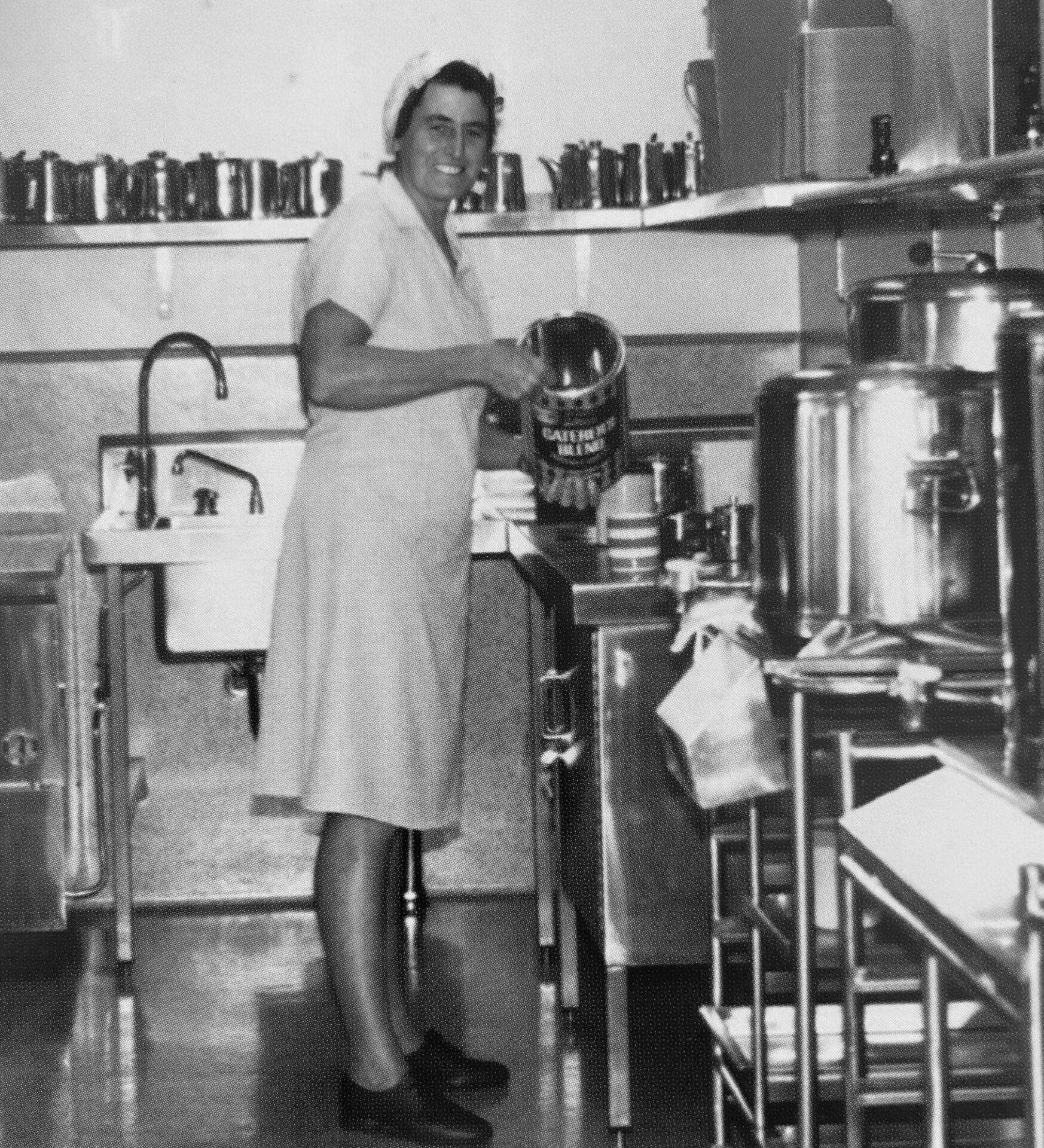
The kitchen was another place where lasting friendships were formed and high standards were established.
Long before patient experience became a recognised focus of healthcare, St Andrew’s understood that good food played an important role in recovery. Cecilia Aitchison laid many of the foundations of the Hospital’s catering service, working alongside dedicated colleagues including Nellie Higgins, Mary Nugent and Jan Saunders.
For decades, meat supplier Max Wilkins arrived at the Hospital before dawn and often found Nellie already hard at work preparing breakfast. She became one of the familiar faces of the kitchen, helping ensure patients started their day with a hot meal and a friendly welcome.
Mary Nugent was equally respected for her practicality and common sense. When regulations created challenges for food deliveries, she was known for finding sensible solutions that kept the kitchen running smoothly.
Jan Saunders (pictured) initially started in tray services in the kitchen, became a patient assistant in the high dependency unit, was secretary of the auxiliary from 1998 and continues to work on the St Andrew’s Hospital flower roster.
“The patients really appreciate having their flowers done and it gives them somebody to talk to. It helps to brighten their day and we also get to build relationships with the patients.”
Another long-term member of staff is Jenny Baxter, who began working at the hospital in 1995 as a Catering Services team member and still faithfully serves at the cafe 31 years later!
Keeping the hospital moving
As St Andrew’s expanded, so too did the need for a team dedicated to moving patients, supplies and equipment throughout the growing Hospital.
Barry Smith was one of the early leaders of the wardsmen. When Bob Turner joined St Andrew’s in 1987 after serving in the Army, Barry was already overseeing many of the Hospital’s patient transport responsibilities. Bob would later succeed him, spending years managing wardsmen and housekeeping operations.
Their days were filled with transporting patients to X-ray, plaster rooms and specialist departments. Wheelchairs, stretchers and a constant stream of requests became part of everyday life.
The role demanded patience, flexibility and often a sense of humour. Bob remembered occasions when patients were accidentally delivered to departments they were never meant to visit, with the mistake only discovered later. There were also more serious challenges, including a severe storm that flooded parts of the Hospital and required an extraordinary clean-up effort.
Through every challenge, Bob believed one quality defined St Andrew’s above all others:
“In the early days there was great comradeship and we were like one big family.”
His words capture a theme that appears again and again throughout the Hospital’s history.
The builders and problem solvers
Hospitals rely on far more than clinical care. Behind every ward and operating theatre is a network of systems that must function perfectly day and night. At St Andrew’s, maintenance staff carried much of this responsibility.
Daniel Fitzpatrick was among the early maintenance personnel who helped support a rapidly growing Hospital. Working closely with Kenn Zerner, he formed part of a very small team responsible for boilers, pumps, heating systems and the countless pieces of equipment essential to daily operations.
Their work often went unnoticed because everything was running smoothly. It usually became visible only when something stopped working.
As the Hospital grew, so too did its maintenance department, evolving from a modest operation into a sophisticated engineering service capable of supporting modern healthcare facilities.
Fresh linen, every day
Few patients ever visited the laundry, yet it was one of the Hospital’s most important departments. Every bed sheet, gown, towel and curtain passed through the hands of laundry staff before reaching patients.
For many years, Roger Shore oversaw the department. By the mid-1990s, the Hospital had outgrown its existing laundry facilities. Rather than continue relying on outdated equipment, Roger helped plan and implement a modern laundry complex designed to support future growth.
The new facility significantly improved efficiency and hygiene standards while reducing dependence on external providers. It was another example of how St Andrew’s behind-the-scenes services evolved alongside its clinical care.
Leading a new era
As St Andrew’s entered the modern era, new clinical leaders helped guide the Hospital through periods of growth and transformation.
Among them was Nadja Hartzenberg, who arrived from South Africa with extensive intensive care experience. She played a key role in developing the Hospital’s first Intensive Care Unit, a significant milestone that expanded the complexity of services available at St Andrew’s and represented an important advancement for private healthcare in Toowoomba.
Heather Moon also helped shape the Hospital’s future. As Director of Nursing and later Director of Clinical Services, she oversaw major developments including the Diagnostic Breast Clinic, Mental Health services and the opening of the John Stedman Cancer Centre.
Continuing that progress, Fiona Brown joined the Hospital in 2006. Drawing on her experience in private healthcare management, she strengthened the Hospital’s focus on accreditation, clinical governance and quality systems while supporting major developments such as the Cancer Care Centre.
Together, these leaders helped guide St Andrew’s confidently into the twenty-first century.
A shared legacy
One theme emerges consistently from the recollections of former staff: St Andrew’s felt like a family. That culture was not created by board members, doctors or matrons alone. It was built by hundreds of people whose contributions often took place far from public view.
The people mentioned here, and many more, all played a role in transforming a small 42-bed hospital into one of regional Australia’s leading healthcare institutions. The story of St Andrew’s Hospital would not be complete without them.